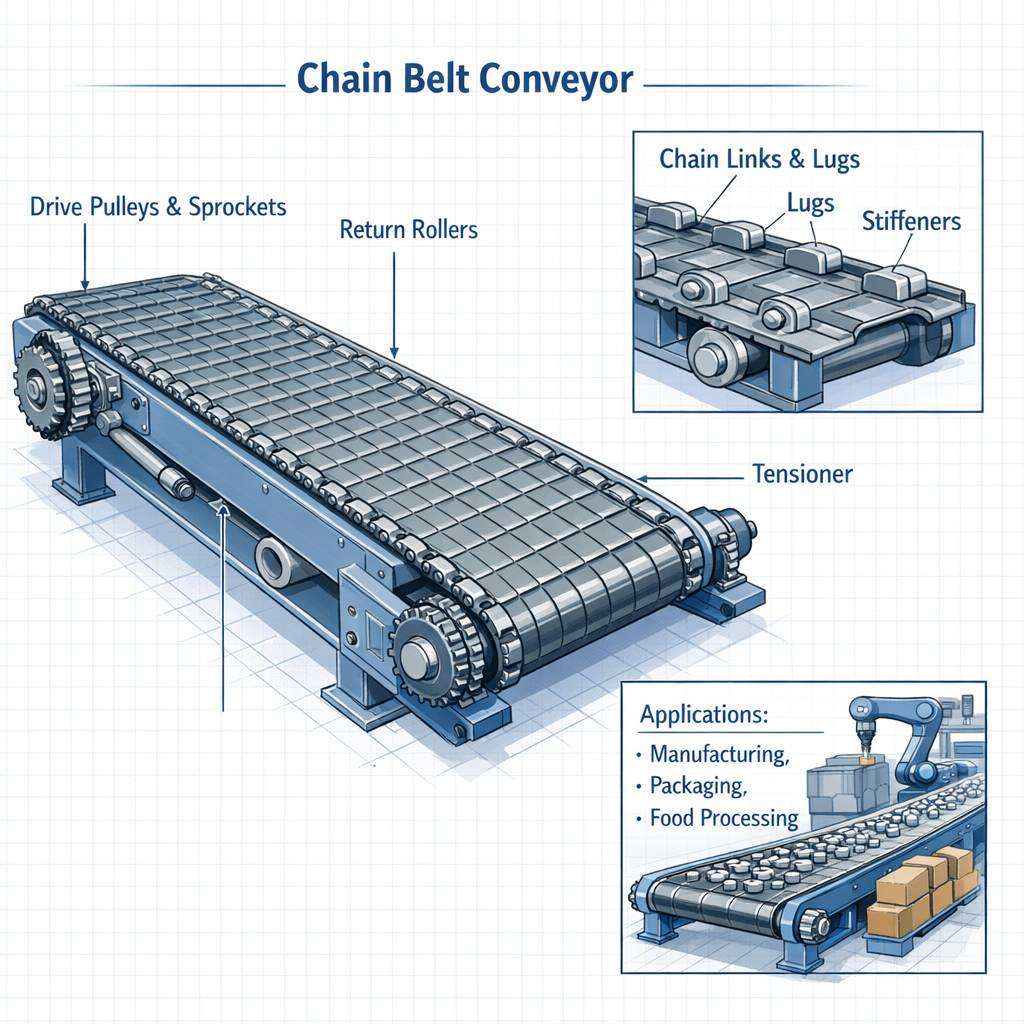
Chain belt conveyors are a dependable workhorse in modern material handling. They bridge the gap between simple gravity flow and complex automated systems, providing a robust and versatile solution for transporting a wide range of products. In this post, I’ll unpack how a chain belt conveyor works, highlight the key components, and explore typical applications. Whether you’re evaluating a machine for a production line or comparing the options from a belt conveyor company, this overview should give you a solid, practical understanding.
A chain belt conveyor offers robust material handling for heavy loads, delivering reliable performance in manufacturing, packaging, and logistics environments. Its interconnected chain design ensures smooth, continuous motion, reduces slippage, and withstands challenging conditions. For quality components and rollers, visit https://conveyorrollers.co.uk for trusted sourcing. This setup minimizes downtime and improves overall efficiency across diverse operations.
How a chain belt conveyor works
At its core, a chain belt conveyor uses a chain-driven belt to move items along a defined path. Unlike a flat belt, the chain belt consists of interlinked plates or flights connected to a chain that travels around pulleys. The chain is driven by a motor and gearbox, which coordinates with a tensioning system to keep the belt taut and the motion smooth.
When the drive motor turns, it rotates the drive pulley. The linked chain and attached flight plates engage with the return rollers and the tracking guides, pulling the belt forward. The items resting on the belt are conveyed along the system, typically at controlled speeds and with adjustable incline or decline as required by the application. The resilient chain and modular plates provide a uniform, positive drive that minimises slippage and allows for precise movement—critical in handling delicate products or high-speed lines.
One of the primary advantages of a chain belt conveyor is the ability to handle heavy loads and varied product shapes. The chain’s rigidity and the robust frame supporting the belt reduce sagging and misalignment, which is especially important for long conveyors or those with tight curves.
Key components of a chain belt conveyor
- Drive and return chains: The heart of the system, delivering propulsion and ensuring the belt cycles smoothly. The drive chain is connected to a motor and gearbox, while the return chain helps stabilise the belt on the return run.
- Chain belt: The linked plates or flights form the transporting surface. In heavy duty belt conveyors, these plates are engineered to withstand impact, abrasion, and heavy loads.
- Pulleys and rollers: Drive and idler pulleys guide the belt’s path. Return rollers support the belt on the return side, keeping it aligned and reducing friction.
- Tensioning system: Proper tension is essential for performance and longevity. Automatic or manual tensioners compensate for wear, temperature changes, and belt elongation.
- Side rails and guards: These components keep products on the belt and protect workers from moving parts.
- End stops and loading zones: End stops prevent overruns, while loading zones are designed to calm product entry, reducing jamming and damage.
- Control system: A belt conveyor system is equipped with variable speed drives, sensors, and safety interlocks to manage speed, direction, and emergency stopping.
A chain belt conveyor system offers robust handling for heavy loads, precise motion, and reliable durability in challenging environments. Its rugged design reduces maintenance while delivering smooth belt tracking and consistent transfer accuracy. For additional details and product specifications, explore the link in the second half: https://www.mknorthamerica.com/Products/plastic-modular-belt-conveyors/modular-plastic-belt-conveyor-mbf-p-204002/.
FAQ: Chain Belt Conveyor
What is a chain belt conveyor?
A chain belt conveyor is a type of conveyor system that uses linked chains as the carrying surface. It combines a chain belt moving over pulleys or sprockets with a supporting frame, offering durability and the ability to transport heavy or bulky items, including hot, sharp, or abrasive materials.
How does a chain belt conveyor differ from a roller conveyor?
- Chain belt conveyors use interlinked chains as the carrying surface, providing strong load-bearing capacity and resistance to damage.
- Roller conveyors use rotating rollers and are typically better for light to medium loads and easier item transfer between lines.
- Chain belt conveyors are often used for inclined or declined paths, heavy-duty applications, and applications requiring a solid, non-slip surface.
What are common uses for chain belt conveyors?
- Handling heavy parts, metal components, or tooling
- Food processing where a robust, easy-to-clean surface is needed
- High-temperature or abrasive material transport
- Transfers, inclines, or declines in manufacturing lines
- Situations requiring positive tracking and reduced risk of item slippage
What materials are chain belts made from?
Chain belts can be made from:
- Stainless steel for corrosion resistance and easy cleaning
- Carbon steel with protective coatings for strength and affordability
- Plastic or polymer chains in lighter-duty, food-grade, or washdown environments
What are the advantages of chain belt conveyors?
- High load-bearing capacity and durability
- Strong resistance to wear, impact, and in some cases heat
- Good for irregular-shaped or large items
- Positive tracking and reduced slippage due to continuous chain surface
- Suitable for inclines, declines, and legs of transport
What are potential drawbacks or considerations?
- Higher initial cost and maintenance compared to basic roller conveyors
- Requires regular lubrication and tensioning of chains
- Can be noisier depending on drive and mounting
- Cleaning and sanitisation considerations in food or pharma environments
How do you maintain a chain belt conveyor?
- Inspect chains, sprockets, and bushings for wear; replace as needed
- Check tension and lubrication according to manufacturer specs
- Clean the chain belt to remove debris, dust, or residues
- Inspect bearings, drive motor, and reducers for proper operation
- Ensure proper alignment and track of the chain belt to prevent derailment
Can chain belt conveyors handle different materials and shapes?
Yes, they are versatile for a range of items, including parts, pallets, boxes, or components with irregular shapes. However, part geometry, weight, and surface finish should be considered to prevent damage or slippage.
Are chain belt conveyors suitable for food and cleanliness-sensitive environments?
Many chain belts are designed with food-grade materials and finishes (e.g., stainless steel, FDA-approved lubricants, easily cleanable surfaces). Ensure the belt and components meet your industry’s cleanliness standards and regulatory requirements.
What maintenance schedule should I follow for a chain belt conveyor?
- Daily: quick visual inspection of chain tension, alignment, and drive operation
- Weekly: check lubrication levels, remove buildup, confirm noise levels
- Monthly: inspect sprockets, bearings, and chain wear; measure chain stretch
- Annually: comprehensive inspection, possible replacement of worn components, and system calibration
How do I choose the right chain belt conveyor for my application?
- Load weight and dimensions of items
- Required incline/decline angle and travel distance
- Environmental conditions (temperature, moisture, chemicals)
- Material compatibility and cleanliness requirements
- Space constraints and integration with existing equipment
What safety features are common with chain belt conveyors?
- Emergency stop devices and safety interlocks
- Guarding and protective fences around moving parts
- Safety rollers and proper guarding at drive areas
- Proper machine guarding for maintenance access
- Lockout/tagout procedures for servicing
If you’d like, tell me your specific application (item size, weight, environment), and I can tailor recommendations for a chain belt conveyor solution.
A chain belt conveyor efficiently handles heavy loads with durable sprocket-driven motion and precise tracking. It’s ideal for demanding manufacturing lines, ensuring smooth transfer and reliable performance under continuous use. Explore solutions at https://hytrol.com/products/transport/belt-over-conveyor/.
Chain belt conveyors offer reliable material handling for continuous production lines, combining robustness with compact design. Their low-profile profiles allow efficient space usage while maintaining high belt stability and smooth transfer of heavy loads. Maintenance is straightforward with accessible rollers and tensioning systems. For more information on suitable models and configurations, visit conveyorrollers.co.uk to explore versatile options. Choose a chain belt conveyor to optimize throughput and efficiency across manufacturing operations.
Variations within the chain belt family
- Heavy duty belt conveyor: Built for maximum load, high throughputs, and challenging environments. Heavy duty models use thicker chain links, reinforced plates, and rugged motors to withstand continuous operation.
- Modular belt conveyor systems: While not strictly the classic chain belt, modular belt conveyors share the principle of using interlocking segments. They offer exceptional versatility for sorting, indexing, and accumulating, and they’re easy to reconfigure for changing production lines. Modular belt conveyors can be adapted for incline/decline and specialty products, making them a popular choice in modern facilities.
- Standard chain belt conveyor: Ideal for general material handling, these systems balance cost, performance, and reliability for many applications.
- Inclined/declined chain belt conveyors: An inclined configuration enables elevation changes without additional transfer mechanisms. These are common in warehouses, packaging lines, and food processing where gravity cannot be relied upon to move products.
Design considerations and selection criteria
- Load characteristics: Weight, size, and rigidity of the product determine belt material, plate design, and motor sizing.
- Throughput and speed: Desired lines per minute or hour influence motor power, gear ratios, and belt pitch.
- Product care: Delicate items require smoother starts, controlled acceleration, and gentler handling features. In some cases, modular belt systems are preferred for gentler transport and easy cross-compatibility with different products.
- Environment: Temperature, dust, moisture, and chemical exposure can impact belt material choice and protective coatings. Heavy duty belt conveyors often employ corrosion-resistant components for rugged environments.
- Space and layout: The path length, curves, and available ceiling or floor space determine pulley spacing, belt width, and the feasibility of a chain belt versus other designs.
- Maintenance: Accessibility for cleaning, lubrication, and component replacement is essential. A belt conveyor company will often highlight modular components and standard parts for easier maintenance.
Applications across industries
- Food processing and packaging: Chain belt conveyors are common in wash-down environments and where products require stable, clean transfer surfaces. The chain and plate design resists contamination and allows thorough cleaning between batches.
- Automotive and logistics: Heavy loads, long conveyors, and robust performance make chain belt conveyors suitable for moving crates, pallets, and automotive components along production lines.
- Manufacturing and assembly: Precision movement, dependable drive, and the option for incline transport enable efficient assembly workflows with minimal product handling.
- E-commerce and distribution: For bulk handling and sorting, modular belt systems may be used in conjunction with chain belt conveyors to create flexible, scalable lines.
- Metals and heavy industry: The rugged construction of heavy duty belt conveyors accommodates abrasive materials and demanding operating conditions.
Integrating with a belt conveyor system
A modern belt conveyor system may blend chain belt sections with modular belt segments or other conveyor types to optimise flow. A belt conveyor company can help design a system that matches product mix, throughput targets, and space constraints. They’ll consider how the chain belt interacts with conveyors uk operations, electrical controls, and safety features. When installing, pay attention to alignment, tension settings, and guarding to maintain reliability and safety over the life of the equipment.
For facilities evaluating options, it’s worth noting that chain belt conveyors provide substantial load capacity and durability. If your operation prioritises easy reconfiguration, modular belt conveyor systems might offer the most flexibility, often at a lower total cost of ownership in dynamic environments.
Whether you’re upgrading an existing line or designing a new one, the choice between a traditional chain belt conveyor and modular belt conveyor solutions should hinge on product characteristics, required throughput, and the accessibility of maintenance resources. A reputable belt conveyor company can help you map these considerations to a practical layout.
If you’re sourcing equipment in the UK, you’ll find a range of belt conveyors UK suppliers, including specialists in heavy duty belt conveyors and modular belt conveyor systems. Collaborating with experts who understand both the technical and regulatory aspects of UK manufacturing and warehousing can make a meaningful difference to performance and longevity.
