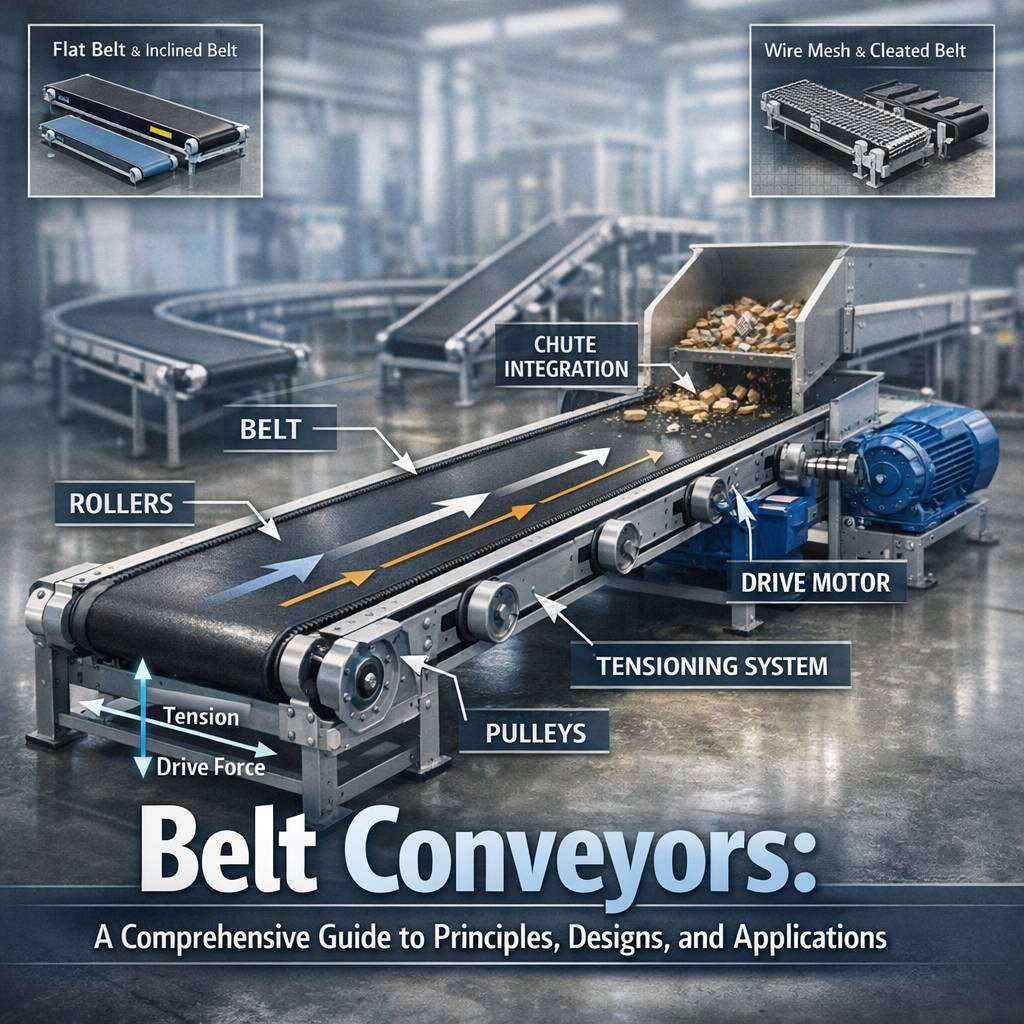
Belt conveyors are the unsung workhorses of modern material handling, quietly keeping goods moving through warehouses, factories, farms, and distribution centres. As an expert in the field, I aim to demystify their core principles, explore the range of designs, and highlight practical applications. This guide uses British English spelling and includes practical insights for organisations seeking reliable, efficient conveying solutions.
Core principles and performance factors
At its essence, a belt conveyor uses a continuous loop of material (the belt) that runs over pulleys to transport products from one point to another. Key performance factors include:
- Load capacity and belt strength: The belt must support the weight of conveyed items and resist wear in demanding environments.
- Drive power and tensioning: A powered belt conveyor requires a suitably sized motor, gearbox, and tensioning system to maintain proper belt tension without slippage.
- Material and belt type: Flat belt conveyors typically use a smooth belt surface, while modular or rough-top belts can improve grip for irregular items.
- Rollers and support structure: Roller systems influence conveying efficiency, alignment, and trackability, especially for longer runs.
- Safety and ergonomics: Guarding, emergency stops, and accessible workspace are integral to compliant, humane operation.
When selecting a system, engineers assess product dimensions, load distribution, environmental conditions, and the desired transfer points to determine the optimal belt width, speed, and drive arrangement.
Design varieties: from simple to sophisticated
There are several common belt conveyor designs, each suited to different tasks. Below are a few that appear frequently in practice.
Flat belt conveyor
The most traditional and versatile format, a flat belt conveyor uses a flat belt supported by rollers or a slider bed. It’s well-suited to general material handling, automotive parts, and packaging lines. A flat belt offers a stable surface for uniform items but may require additional guidance for small or irregular loads.
Roller belt conveyor
This design combines a belt with roller assistance, typically using a low-friction belt and roller bed to reduce energy consumption and promote smooth movement. Roller belt conveyors are advantageous for heavier payloads and longer runs where friction needs to be minimised.
Chain driven belt conveyor
In a chain driven belt conveyor, a chain mechanism drives the belt through friction or direct engagement. This arrangement can deliver higher torque, robust uptime, and precise control, making it suitable for heavy-lift applications, inclined layouts, or environments demanding dependable acceleration and braking.
Belt conveyors streamline production lines, boosting efficiency and reducing manual handling. With reliable design, they improve throughput while minimizing downtime. Operators should consider maintenance access, power consumption, and safety features to maximize performance. For further reading on governance and sustainability considerations, see the following resource in the second half: https://kleinmanenergy.upenn.edu/research/publications/the-net-zero-governance-conveyor-belt/
Agricultural belt conveyors
Designed for farm and agribusiness settings, agricultural belt conveyors account for rough, dusty conditions and sometimes uneven fruit or vegetable loads. These systems prioritise resilience, ease cleaning, and gentle handling to protect produce. They may incorporate angled sections and removable belts for maintenance-friendly operation.
Inclined belt conveyor
Inclined configurations are critical when moving materials between levels or into mezzanines. Special considerations include belt selection for grip, load shifting risks, and the required drive power to overcome gravity. Precision in tensioning and robust tracking are essential to prevent slip on steep slopes.
Belt conveyors enable efficient material handling across industries, improving throughput and reducing manual labor. When selecting systems, consider belt strength, return rollers, and maintenance access to maximize uptime. For safety and compliance basics, explore industry guidelines and best practices. http://www.msha.gov/safety-and-health/safety-topics/safety-topics/safety-topic-conveyor-systems
Powered belt conveyor
A powered belt conveyor uses an electric motor-driven pulley or a belt motor to propel the belt. Variable speed drives enable fine control over throughput and can integrate features like automatic sortation, diverting, or braking. In many warehouses, powered belts are paired with automation to streamline processes.
Belt conveyors streamline material handling across manufacturing floors, boosting efficiency and reducing manual labor. These systems rely on durable belts, rollers, and control technologies to move items smoothly between workstations. When selecting equipment, consider load capacity, speed, and durability to match production needs. Maintenance should focus on belt tension, alignment, and motor health to minimize downtime. For more insights, visit this resource in the second half: https://www.iqsdirectory.com/articles/conveyors/belt-conveyors.html. Belt conveyors remain a versatile solution for continuous, reliable material transfer.
FAQ: Belt Conveyors
What is a belt conveyor?
A belt conveyor is a mechanical handling system that uses a continuous moving belt to transport materials from one location to another. It’s commonly used in manufacturing, packaging, mining, and distribution facilities to move bulk goods, parts, and products efficiently.
How does a belt conveyor work?
A belt conveyor uses pulleys (driven and idler), a belt, and a motor to create motion. The belt loops around the pulleys, and the motor drives the belt, which in turn carries materials from the loading point to the discharge point. The system may include rollers, tensioners, and controls to manage speed and direction.
What are the main types of belt conveyors?
- Horizontal belt conveyors
- Inclined/Declined belt conveyors
- declined belt conveyors
- Cleated belt conveyors
- Curved belt conveyors
- Roller bed vs. smooth belt conveyors
- Food-grade belt conveyors
- Modular belt conveyors
What materials can belt conveyors handle?
Belt conveyors can handle a wide range of materials, including loose bulk materials (grains, coal, sand), packaged goods (boxes, totes, cartons), and items with irregular shapes. Specialty belts are available for heavy loads, sharp edges, hot materials, or hygienic environments.
What factors should be considered when selecting a belt conveyor?
- Load size, weight, and density
- Belt width and speed
- Desired incline/decline and overall conveying distance
- Material characteristics (abrasiveness, moisture, temperature)
- Duty cycle and maintenance requirements
- Environment (dust, humidity, exposure to chemicals)
- hygiene and sanitation needs (for food/pharma)
- Electrical controls, safety features, and certifications
How do I calculate belt conveyor capacity?
Capacity depends on belt width, belt speed, and material characteristics. A simplified formula is:Capacity = Belt Width x Speed x Material Cross-section Load FactorFor precise calculations, use manufacturer standards or a conveyor engineering calculator, considering the material’s bulk density and the belt’s incline angle.
What maintenance is required for belt conveyors?
- Regular inspection of belt wear, mistracking, and belt tension
- Checking pulleys, rollers, and bearings for wear
- Cleaning to prevent material buildup
- Lubrication of drive components per manufacturer guidelines
- Inspection of safety features, guards, and emergency stops
- Replacing worn or damaged belts promptly
How reliable are belt conveyors and how long do they last?
Reliability depends on design, usage, and maintenance. With proper selection and routine maintenance, belt conveyors can provide many years of continuous service. Regular inspections and timely component replacement extend life and reduce downtime.
Are belt conveyors safe to use?
Yes, when correctly designed and installed and operated with proper safety protocols. Features often include emergency stop devices, belt guards, guards around moving parts, pull cords, and safety interlocks. Training and lockout/tagout procedures are essential.
What are common belt conveyor problems and how can I prevent them?
- Mis-tracking: ensure proper belt alignment, correct pulley rotation, and adequate tension.
- Belt wear and slippage: monitor tension, use appropriate belt material, and replace worn belts.
- Material spillage: use side guards or flanges, and ensure proper loading.
- Seized or noisy bearings: maintain lubrication and replace worn bearings.
- Belt elongation: adjust tension and check for driving issues.
How do I prevent belt contamination in food- and pharma-grade conveyors?
- Use food-grade or sanitizable belt materials (e.g., FDA-approved polyurethane or PVC)
- Implement clean-in-place (CIP) or clean-out-of-place (COP) procedures
- Seal bearings and use washdown-rated components
- Minimize crevices, use smooth surfaces, and ensure easy disassembly for cleaning
Can belt conveyors handle inclines and declines?
Yes, many belt conveyors are designed for inclined or declined transport. The incline angle depends on belt type, load, and friction. Cleated belts or anti-slip features help with steeper angles.
What are common belt conveyor accessories?
- Pulleys, rollers, and idlers
- Take-up and tensioning systems
- Chutes, scoops, and hoppers
- Curved sections and vertical conveyors
- Safety guards, sensors, and emergency stops
- Transfer or loading zones and live roller sections
How do I choose between a belt conveyor and alternatives (e.g., roller conveyors, chain conveyors)?
Consider the material type, weight, handling requirements, installation space, and desired friction. Belt conveyors are ideal for bulk, irregular items, or gentle handling; roller conveyors work well for flat, stable items on a level path; chain conveyors handle heavy or hot loads and precise indexing. A material handling consultant can help tailor the choice to your process.
Applications across industries
Belt conveyors find utility in a broad spectrum of sectors:
- Warehouse belt conveyor systems support order picking, packing, and bulk movement ofgoods between loading docks and storage zones.
- Manufacturing lines use belt conveyors to transfer components between workstations, aligning with assembly cycles.
- Agricultural operations employ inclined and horizontal belts for processing, sorting, and packaging crops with care.
- Airport baggage handling and post‑processing facilities rely on dependable belt systems for smooth, fast transport.
- Recycling and waste management plants use rugged belt conveyors to move materials through sorting and processing stages.
Belt conveyors boost production efficiency by moving materials smoothly along production lines, reducing handling times and labor costs. With robust designs and reliable performance, these systems handle diverse loads and harsh environments. Maintenance is straightforward, minimizing downtime. For more information, visit our partners and explore cost-effective options: www.conveyorrollers.co.uk.
Selection considerations and best practices
Choosing the right belt conveyor involves balancing performance, cost, and longevity. Consider the following:
- Throughput requirements: Calculate the desired metres per minute and select a belt width and motor with adequate capacity.
- Load characteristics: Uniform items are easier to convey; irregular or fragile goods may benefit from protective belt coverings or live-roller sections.
- Environmental conditions: Temperature, dust, moisture, and chemical exposure influence belt material and sealing needs.
- Maintenance strategy: Access to spare parts, ease of cleaning, and routine inspection plans affect total cost of ownership.
- Integration with safety systems: Ensure compatibility with sensors, emergency stops, and lockout/tagout procedures.
To optimise operation, employ a comprehensive maintenance schedule that includes belt tracking checks, pulley alignment, belt tension adjustments, and motor bearings inspection. Regular cleanliness and debris removal especially matter in agricultural and waste-handling environments, where contamination can degrade performance.
Selecting a belt conveyor supplier and solutions
When partnering with a belt conveyor supplier, look for:
- Experience and references in your industry sector.
- A broad product portfolio that covers flat belt, roller belt, chain driven belt, inclined, and modular variants.
- Customisation capabilities to tailor belt width, drive type, and frame configuration to your space.
- After-sales service, spares availability, and on-site support for installation and commissioning.
- Clear documentation on safety, maintenance, and energy efficiency features.
For organisations seeking integrated systems, a reputable supplier can offer end-to-end services—from design and installation to training and ongoing maintenance.
Practical tips for efficient operation
- Align and tension the belt correctly to minimise wear and energy use.
- Use energy‑saving drive options, such as regenerative braking or variable speed drives, to match throughput with demand.
- Implement modular sections for easy scalability or re-routing during facility changes.
- Plan for future growth by selecting a belt conveyor with upgrade paths or adjustable speeds.
- Invest in protective covers and guarding to meet health and safety standards while keeping maintenance accessible.
Belt conveyors, in their many guises, deliver reliable, scalable transport across facilities. Whether you operate a warehouse belt conveyor network, depend on a roller belt conveyor for heavy items, or manage agricultural belt conveyors in a processing line, the right design—paired with thoughtful integration and ongoing care—will keep your materials moving smoothly and safely. If you’re evaluating options, a seasoned belt conveyor supplier can help map requirements to a robust solution that fits today’s needs and tomorrow’s ambitions.
