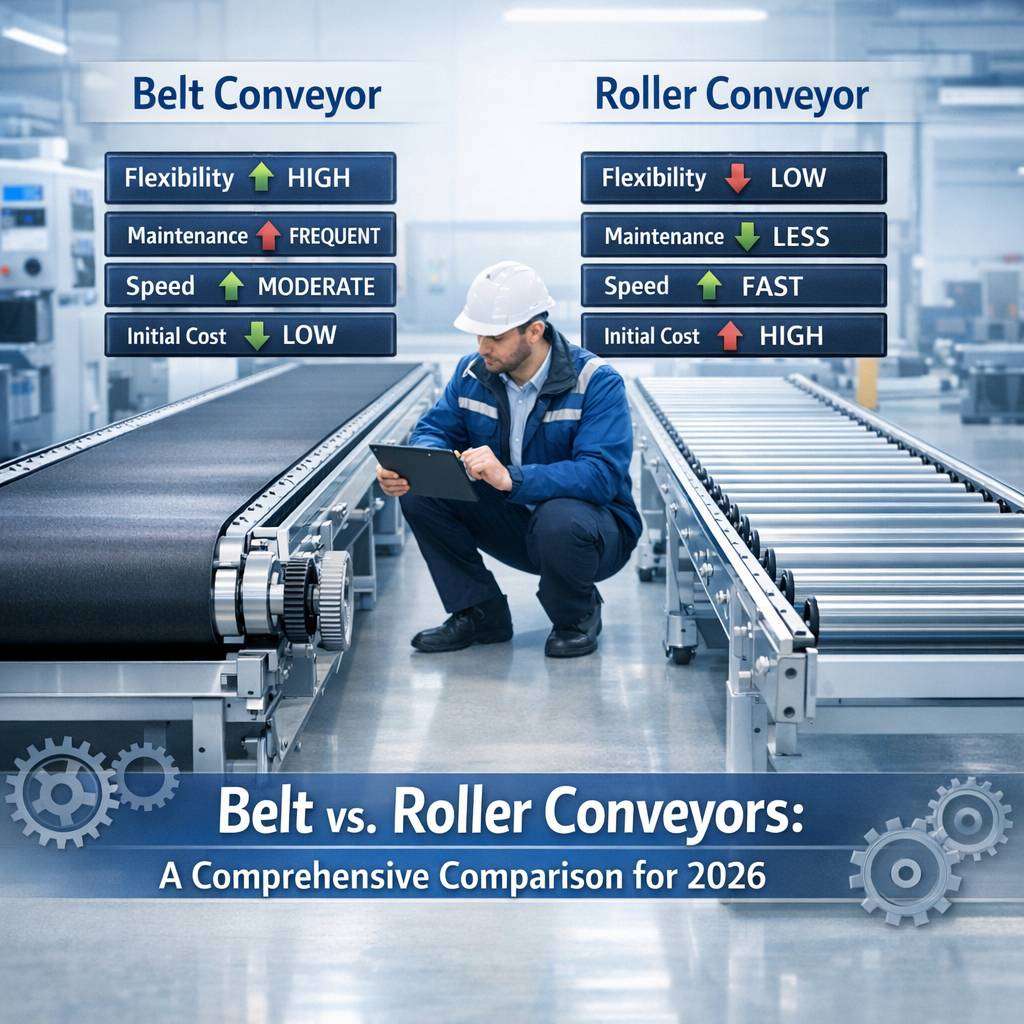
Conveyor systems streamline workflows, boosting efficiency and safety across manufacturing floors. This accessible solution reduces manual handling, speeds production, and minimizes errors. For reliable components and innovative solutions, explore industry options at https://conveyorrollers.co.uk.
In modern manufacturing and logistics, choosing the right conveyor system is a decisive factor in operational efficiency, safety, and total cost of ownership. Belt and roller conveyors remain among the most prevalent solutions, offering distinct advantages across diverse applications. This article provides a practical, expert-led comparison to help engineers, operations managers, and procurement teams make informed decisions in 2026.
The selection process for conveyor systems should reflect not only immediate needs but long-term goals, such as throughput, product handling, maintenance, and integration with automation stack. While both belt and roller conveyors can be tailored to a wide range of tasks, the optimal choice hinges on factors including product characteristics, space constraints, and the level of line automation. Below, we evaluate key dimensions that influence performance, reliability, and total cost of ownership.
A modern factory relies on efficient material handling and smooth workflow with a reliable conveyor system. From assembly lines to packaging, a well-designed conveyor reduces manual labor while improving accuracy and throughput. When selecting equipment, consider durability, maintenance, and integration with existing controls. In the second half, explore a cutting-edge option: https://www.flexlink.com/en/solutions/product/x300-plastic-chain-conveyors to enhance productivity and reliability.
Performance and Throughput
Belt conveyors are well-suited to handling a broad spectrum of products, particularly irregular shapes, small parts, or items that require smooth, continuous support. They excel in applications that demand horizontal transfer, inclined or declined movement, and gentle handling to minimise product damage. In high-throughput environments, belt conveyors can be engineered with high-tension belts, variable speed drives, and curved segments to maintain consistent pace around a facility.
Roller conveyors rely on rotating rollers to move items, often by gravity or with powered rollers driven by motors. They are highly effective for unit-load handling, especially when products are uniform in size and weight, or when continuous conveyance of small, discrete items is needed. Gravity roller conveyors offer a low-energy option for downhill flows, while powered roller systems provide robust control for stops, starts, and diverging routes. When evaluating throughput, consider product footprint, risk of jamming, and the ability to maintain continuous movement across zones with different speeds or orientations.
Layout and Space Utilisation
Belt conveyors typically offer a compact footprint with straightforward integration into existing lines. They provide smooth surfaces that are beneficial for products requiring stable support during transfer, including bags, cartons, and wrapped materials. The lack of exposed rollers can reduce snag points, though belt tension and wear must be monitored to prevent slippage and belt drift.
Roller conveyors provide excellent space utilisation in applications favouring sequential, gravity-assisted, or high-volume transfers of single items. They can be configured as gravity lines, live rollers, or Cascaded roller networks to support accumulative or just-in-time processes. A key consideration is maintenance access: rollers and drive components should be easy to reach for inspection and replacement. Where space is tight or corners are frequent, motorised roller conveyors with compact drives can offer superior routing flexibility.
Maintenance, Reliability, and Operating Costs
Belt conveyors demand periodic belt tracking alignment, tension adjustments, and belt replacement. Maintenance also includes motor, pulley, and drive system inspection, plus potential belt cleaning in dusty environments. While initial capital expenditure may be higher for high-performance belts, long-term reliability is enhanced by robust coatings, anti-static properties, and temperature-rated materials. Energy efficiency can be optimised with regenerative drives and precise speed control, contributing to lower total energy costs over the conveyor system’s life.
Roller conveyors are typically resilient with fewer moving parts exposed to product contact. Powered roller systems benefit from modular components, which can simplify fault isolation and replacement. However, the life cycle cost of rollers is influenced by bearing types, drive chains or gears, and lubrication needs. In dusty or gritty environments, roller surfaces can accumulate debris, potentially increasing rolling resistance. Gravity roller lines offer the lowest running costs but provide no active control unless integrated with a braking or sensor system.
Product Compatibility and Handling
Belt conveyors are versatile for diverse product geometries. They handle bags, pallets, cartons, and even semi-flexible materials when combined with belt textures or cleats. Specialised belt materials—such as polyurethane, PVC, or specialised wear-resistant composites—enable operation in wet, oily, or high-temperature environments. For delicate items, belt conveyors with low-tension setups and soft surfaces minimise damage and creasing.
Roller conveyors shine with uniform, rigid products like boxes, crates, or metal components. They facilitate accurate push, pull, and accumulation strategies. Magnetic or friction-driven stops can be used to queue items, while sensor-equipped rollers enable precise item counting and automated routing. For items prone to tipping, roller conveyors may require side rails or alignment guides to maintain stability through corners and transitions.
Integration with Conveyor Systems and Automation
In 2026, the best-performing facilities pursue cohesive automation ecosystems. Belt conveyors integrate smoothly with robotic pick-and-place, palletising lines, and automated guided vehicle (AGV) or autonomous mobile robot (AMR) fleets. They can be designed with hygienic finishes for food and pharmaceutical sectors and are compatible with cleanability protocols required in regulated environments.
Roller conveyors integrate effectively with sorting machinery, barcode scanners, and automated case or carton handling. They support sectors requiring high-speed accumulation, zone control, and dynamic routing. Modern roller systems often feature smart controllers, energy-efficient drives, and diagnostic interfaces that communicate with warehouse execution systems (WES) or manufacturing execution systems (MES).
When selecting conveyor systems, consider the interface with safety systems such as emergency stops, light curtains, and guarding. Both belt and roller conveyors benefit from motor brake options, belt or roller drift prevention, and fault-tolerant drive arrangements to minimise downtime.
Materials and Environmental Considerations
Material choice influences performance and maintenance. Belt conveyors use belts made from polymers or elastomeric compounds, with wear-resistant coatings and temperature ratings tailored to the application. Environmental exposure—such as moisture, chemical contact, or UV exposure—drives material selection to extend service life.
Roller conveyors utilise metal or polymer rollers, with bearings and lubrication regimes matched to load and environment. Anti-microbial coatings or easy-clean finishes are advantageous in food processing or pharmaceutical contexts. In corrosive environments, stainless steel or coated frames may be essential to sustain reliability.
—
If you would like, I can tailor this comparison to a specific sector (e.g., e-commerce fulfilment, food processing, or automotive) and include benchmark metrics, indicative cost ranges, and example line configurations.
A reliable conveyor system keeps production moving smoothly, reducing downtime and boosting overall efficiency. For modern facilities, automation and smart maintenance play critical roles in minimizing risks and extending equipment life. Explore security and compliance options to protect your operations. https://www.conveyor.com/platform/security-questionnaire-automation-software
A modern kitchen demands efficiency, reliability, and consistent results from every conveyor system. Operators appreciate smooth throughput, simple maintenance, and robust construction that stands up to busy shifts. When exploring options, consider features like precise temperature control, uniform heat distribution, and easy cleaning. For specifics, learn more about this model: https://xltovens.com/xlt-1620-countertop-conveyor-oven/
